Noosa has an unwinded coastal feel, yet anyone who has lived or worked here for a while understands how rapidly a regular day can become an emergency. A surf accident, a heat occurrence on a path, a toddler choking at a cafe, a cardiac arrest at a local sports ground. The gap in between a scare and a catastrophe frequently boils down to whether someone close by understands what to do in the first few minutes.
That is the area high quality first aid training in Noosa is meant to fill. Not simply to tick a workplace box, but to provide residents and visitors enough self-confidence and skill to act when it counts.
First Help Pro Noosa focuses on practical, nationally recognised first aid and CPR courses that are tailored to how individuals here really live, work, and play. If you are trying to choose which Noosa emergency treatment course makes sense for you or your group, it helps to comprehend what the training includes, where the courses vary, and how to get the most from your time in the classroom.
Why first aid training matters so much in Noosa
Noosa is physically active, outdoorsy, and spread throughout beaches, waterways, bushland, and hectic hospitality locations. That combination produces a particular danger profile.
On the coast, lifeguards and surf lifesavers do an amazing task, however they can not be all over. In the time it takes for aid to reach a swimmer dragged onto the sand, someone near them might need to offer CPR. On a hot day in the hinterland, a bushwalk can become a dehydration or heat exhaustion event. In hospitality, staff face burns, cuts, falls, and allergies, often in crowded spaces.
From a trainer's perspective, this implies Noosa emergency treatment courses require to be heavy on real circumstances. Students take advantage of overcoming things like:
- A kid pulled from a yard pool who is not breathing An older tourist collapsing at a Hastings Street restaurant A mountain bicycle rider with suspected spinal injury on a trail
First Help Pro Noosa sessions are created around the very same national systems of competency you would expect in any emergency treatment course in Noosa, however great fitness instructors ground those units in local truths. That is what turns a dry list into muscle memory that holds up under stress.
Who generally goes to Noosa emergency treatment courses
Across years of training, specific groups show up once again and again in emergency treatment and CPR courses in Noosa, frequently with various concerns and concerns.
Hospitality employees come due to the fact that their venues need a specific ratio of qualified staff, however they usually leave talking about real incidents they have seen: a choking customer, a drunk visitor who dropped stairs, a coworker who sliced a finger on glass wares. They tend to value fast, easy procedures they can apply in a crowded space.
Parents and grandparents typically bring a particular anxiety about choking, fevers, and allergic reactions. In an excellent Noosa first aid course, you can anticipate fitness instructors to spend additional time on paediatric CPR, air passage management in small children, and what to do with burns and head knocks at the playground.
Surf, sport, and physical fitness communities search for emergency treatment training in Noosa that covers trauma, concussion, heat issues, and cardiac emergency situations. Coaches and instructors generally want clear, defensible protocols for deciding when a player can continue and when they require immediate care.
Workplaces, from building to corporate workplaces, focus on compliance and documents. They want to make certain their chosen first aid training in Noosa is nationally identified, lines up with WHS requirements, and results in a legitimate emergency treatment certificate Noosa employers will accept.
If you acknowledge yourself in any of those groups, you will currently have a sense of which circumstances matter most to you. Great trainers welcome that input early and adjust the focus of the day to match.
Core Noosa emergency treatment course options
First Aid Pro Noosa provides a number of kinds of Noosa first aid courses. The names might differ somewhat, but they normally line up with basic national codes and follow similar content.
Here are the main dish types you will see offered as emergency treatment courses in Noosa:
Provide Emergency treatment (basic emergency treatment course Noosa)
The standard work environment emergency treatment course. It covers reaction to most typical injuries and health problems, bleeding, fractures, asthma, anaphylaxis, shock, seizures, and basic event management. It usually consists of CPR as a component.
Provide CPR (standalone CPR course Noosa)
Focused simply on resuscitation techniques for adults, kids, and babies. This is a shorter course and is often taken as a CPR refresher course Noosa personnel do annually.
Provide Emergency treatment in an Education and Care Setting
A professional emergency treatment and CPR course Noosa teachers and child care employees require. It adds more depth on paediatric conditions, asthma and anaphylaxis management strategies, and kid specific scenarios.
Low voltage rescue and emergency treatment combinations
For electrical workers who need both first aid and market specific rescue abilities, frequently run as combined sessions.
Express or combined emergency treatment courses Noosa
These integrate online pre-learning with a shorter face to face session, suitable for people with strong experience or minimal time.
Not every service provider offers every format at every place all year, but Emergency treatment Pro Noosa usually has frequent choices for both full emergency treatment and CPR training Noosa large, consisting of weekend and evening sessions when possible.
What really happens in a First Aid Pro Noosa course
Many individuals get to their Noosa first aid training anxious about tests or worried they will need to memorise hundreds of details. The reality is more practical and more forgiving.
Most emergency treatment courses Noosa homeowners participate in follow a similar structure. You begin with an introduction, safety briefing, and a summary of the day. Fitness instructors frequently ask individuals why they exist and what they want to discover or revitalize, which shapes the examples utilized later.
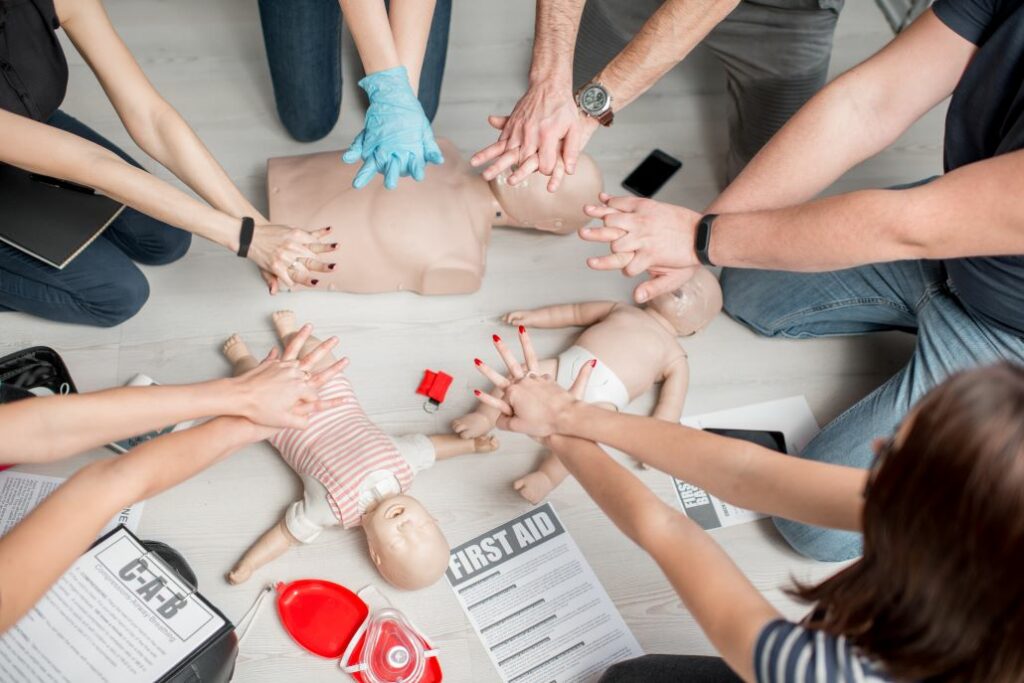
From there, you move into the DRSABCD method: Threat, Reaction, Send out for aid, Respiratory tract, Breathing, CPR, Defibrillation. These steps form the backbone of almost every emergency situation action, from drowning to cardiac arrest to anaphylaxis. Instead of enduring long lectures, you normally practice each step in little groups, rotating through scenarios.
You will spend a considerable piece of time on CPR practice, consisting of compressions on adult, kid, and infant manikins. The equipment typically consists of practical feedback systems that tell you whether your compression depth and rate are on target. For numerous trainees, this is the minute they understand that reliable CPR is physically requiring, and that posture and strategy matter as much as theory.
The remainder of the day cycles through key topics such as choking, bleeding, fractures and sprains, head and spinal injuries, burns, asthma and anaphylaxis, cardiac conditions, stroke, seizures, diabetes, and ecological injuries like heatstroke. Instead of trying to memorise a book, you generally resolve situations, with the trainer fixing and describing as you go.
Assessment in a Noosa emergency treatment course is proficiency based. That suggests you require to demonstrate the required skills, not produce an ideal written test rating. You may have a brief theory test, however the emphasis rests on what your hands do, how you communicate, how you look for threat, and how you require help.
The CPR focus: what to get out of CPR Noosa training
Cardiac arrest does not wait for a hospital or a medical professional. It often happens at home, at work, or in public. In those cases, the person nearest the casualty ends up being the very first responder, despite their task title.
A dedicated CPR course Noosa participants attend typically runs for a couple of hours and centres on a couple of crucial abilities:
Recognising cardiac arrest and unresponsiveness. Individuals are often not sure whether to start CPR. Trainers drill pattern recognition: no action, irregular or no breathing, and no indications of life. The guideline is basic: if in doubt, start.
Effective chest compressions. Hands positioning, arm position, body weight, and rhythm all matter. You practice on manikins to reach that 100 to 120 compressions per minute target, with adequate depth and complete recoil.
Rescue breaths, if consisted of. Many individuals feel reluctant about mouth to mouth. Trainers cover both alternatives: compressions just CPR when breaths are not useful, and complete CPR when a face shield or resuscitation mask is available.
Automated external defibrillator (AED) usage. Modern AEDs are extremely easy to use, but likewise underused. CPR training Noosa courses usually include reasonable AED fitness instructors so you can practice applying pads, following voice triggers, and cleaning bystanders before shocks.
Adapting CPR for children and infants. This is specifically important for parents and those in education and care. You find out how force, depth, and method needs to alter for smaller sized bodies, while the core sequence remains the same.
Most workplaces need CPR refresher course Noosa training every 12 months, since these abilities fade rapidly without practice. From experience, individuals who do CPR Noosa training annual show up calmer and perform much better in simulations than those who have let 5 or 6 years go by.
Blended and reveal choices: saving time without cutting corners
Many adults in Noosa juggle shift work, family commitments, and long commutes. Emergency Treatment Pro Noosa, like many modern suppliers, typically uses mixed or reveal emergency treatment training in Noosa to lower time away from work or home.
In a combined model, you total theory components online at your own speed before attending a much shorter practical workshop. Utilized correctly, this format has two advantages.
First, you can take your time with complicated subjects, replay videos, and refer back to digital resources if something does not click instantly. Second, the in person session can focus greatly on hands on practice, questions, and evaluation, instead of marching through slides.
The trade off is that you need the self discipline to complete the pre course work correctly. Fitness instructors can tell quickly who has engaged deeply and who hurried through late in the evening. If you prefer old fashioned classroom discussion or know you deal with online learning, a full face to deal with Noosa emergency treatment course may serve you better.
Getting and keeping a first aid certificate in Noosa
When you complete a nationally recognised emergency treatment course in Noosa with First Aid Pro or a comparable company, you ought to get a formal statement of achievement, typically delivered digitally within a brief duration after effective completion. This first aid certificate Noosa employers recognise lists the systems of competency achieved, such as HLTAID009 Provide cardiopulmonary resuscitation or HLTAID011 Supply First Aid.
Most general first aid units are considered current for three years under normal office policies, while CPR units are generally suggested for renewal every year. Some industries, such as healthcare and childcare, might implement stricter renewal schedules.
It deserves setting calendar tips for a month or 2 before your certificates expire. Lots of businesses in Noosa run rolling emergency treatment and CPR courses Noosa personnel can attend, and some individuals first aid and cpr course Noosa select to refresh more frequently if they do not feel confident.
Also bear in mind that an emergency treatment certificate Noosa based companies accept in other places in Queensland will generally be identified nationally, provided it is from a registered training organisation (RTO) and matches the needed unit codes. If you prepare to work interstate, this nationwide acknowledgment can save you from repeat training.
Choosing the best Noosa emergency treatment training for your situation
With numerous first aid courses in Noosa on offer, the question shifts from "Do I need training?" to "Which training makes good sense for me today?"
If you work in a standard low threat workplace or retail environment, a basic Noosa first aid course that includes CPR is generally the baseline. You get the broadest coverage and please most WHS requirements in a single day.

If your role puts you in charge of children, such as childcare, school, or sporting programs, an education and care particular emergency treatment and CPR course Noosa based employers recommend is the safer option. The content is more in-depth around paediatric conditions and regulatory requirements, consisting of things like asthma and anaphylaxis management strategies and event reporting.
If you currently hold a current emergency treatment certificate Noosa released and just require to keep your CPR current, a standalone CPR Noosa session or CPR refresher course Noosa personnel frequently take each year might be enough. These much shorter sessions are simpler to set up around work rosters and still provide an important skills tune up.

If you are a company owner or supervisor, you may need to consider a mix obviously. For example, having key personnel complete full first aid training in Noosa, while a broader group completes CPR training Noosa large, can provide you strong protection without sending out everybody off website for a full day.
Finally, personal situations matter. Expecting moms and dads typically prioritise infant CPR and choking management. Older adults may concentrate on heart and stroke acknowledgment. Outside enthusiasts and browse neighborhood members care more about trauma, hypothermia, and spinal factors to consider. Great fitness instructors initially Help Pro Noosa will usually motivate you to ask concerns and guide discussion towards your real concerns.
How a normal day feels: from awkward to capable
People often show up to a Noosa first aid course feeling awkward. The concept of carrying out CPR on a manikin in front of strangers can be frightening, and the evaluations sound official on paper. Within an hour or more, that tension usually eases.
An experienced fitness instructor will break the ice with easy, non technical jobs: putting someone in the healing position, practicing how to approach a scene and check for risk, or function playing a triple zero emergency call. Errors are treated as finding out chances, not failures.
By mid early morning, the room tends to chill out. Participants switch stories of near misses and emergency situation call outs. You start to see patterns. The same handful of concepts keep coming up: check for danger, stay calm, get assist early, understand your limits, communicate clearly.
As the day goes on, you move from separated skills to more intricate situations. That might mean managing numerous casualties after a pretend car crash, or handling a child having an asthma attack while another person is calling for assistance. The fitness instructor walks you through debriefs after each circumstance, pointing out what worked well and where you could tighten up.
The most rewarding minute as a fitness instructor is seeing the shift in body movement near the end of a course. Participants kneel next to manikins with less hesitation, give instructions more plainly, and move with a little bit more purpose. They might still feel anxious about dealing with a genuine emergency situation, however they now have a structure and some real practice to lean on.
Practical suggestions to get the most from your Noosa emergency treatment course
With a bit of preparation, you can turn a standard training day into a truly useful experience that sticks.
Here is a succinct checklist that assists the majority of people improve arise from their first aid and CPR courses Noosa large:
Wear comfy, modest clothes that lets you kneel, bend, and move easily, as CPR and recovery position practice are hands on. Complete any pre course online finding out early, not the night before, so you can show up with questions instead of confusion. Think through the genuine dangers in your life and work, then raise them with the trainer so situations and examples can be customized. Volunteer during session, even if you feel nervous, since muscle memory establishes only through repetition. After the course, evaluate your notes or digital resources within a week to enhance what you discovered, and share bottom lines with household or colleagues.These easy actions often make the difference in between a certificate that beings in your email inbox and abilities you can in fact call on months later.
Frequently asked concerns about Noosa emergency treatment and CPR training
People considering emergency treatment courses Noosa companies offer frequently share the exact same concerns and concerns. Attending to those in advance can take a few of the weight off your decision.
One common question is whether you require previous medical knowledge. You do not. Great emergency treatment course Noosa training presumes no background beyond daily life experience. The role of a very first aider is not to detect or replace paramedics, but to stabilise, assistance, and communicate until expert help arrives.
Another worry includes physical capacity. Requirement Noosa emergency treatment training includes elements like two continuous minutes of CPR on the floor. If you have injuries, pregnancy considerations, or movement limitations, you should let the supplier understand early. Trainers are utilized to adjusting evaluations where possible and can talk you through what is practical and what the official proficiency requires.
People also inquire about language barriers. Lots of first aid training in Noosa sessions can accommodate participants whose mother tongue is not English, specifically if you flag it beforehand. Visual presentations, duplicated practice, and easy, structured protocols assist bridge a few of that space. Sometimes, extra description or equated written product might be available.
Cost and scheduling matter too. Rates vary depending on the course type, supplier, and any discount rates for group bookings. Company owner frequently discover that organizing on site Noosa first aid training for a group ends up being expense reliable as soon as a number of staff requirement certification at the very same time. For people, watching on First Aid Pro Noosa schedules and reserving early often gives the best choice of dates and times.
Finally, individuals often ask whether first aid and CPR Noosa abilities are mentally challenging. The truthful response is that parts of the training can be facing, especially when talking about heart attack, kid injuries, or severe mishaps. Trainers aim to regard that, using breaks and debriefs. Many participants report that having a plan, even an easy one, really reduces stress and anxiety about emergencies in daily life.
Building a more secure Noosa, one course at a time
No single course turns you into a healthcare professional, and no trainer can promise that emergencies will feel easy when they happen. What great first aid pro Noosa training can do is narrow the space between fear and action.
When more residents hold current first aid certificates Noosa wide, the neighborhood becomes more resistant. An internet user who understands how to use an AED may conserve a complete stranger at the health club. A barista who completed a CPR course Noosa based might keep a client alive up until paramedics arrive. A moms and dad who took note in a Noosa emergency treatment course might recognise the indications of anaphylaxis in their own child early enough to make all the difference.
If you live, work, or invest considerable time here, investing a day into first aid and CPR training in Noosa is a useful way to take care of individuals around you. And when the unforeseen occurs, it is those peaceful, useful abilities that often matter most.
Nationally Recognised First Aid Courses Noosa Locals Trust! First Aid Pro is one of Noosa’s leading providers of accredited CPR and first aid courses. Established in 2010, our nationally registered training organisation (RTO) has equipped over 3 million Australians with essential life-saving skills through our experienced team of 110+ expert trainers. Conveniently servicing Noosa and the Sunshine Coast region, we provide top-quality, nationally accredited CPR and first aid training sessions tailored to your needs, whether for workplace requirements, career advancement, or personal safety. From childcare-specific first aid training to advanced first aid and resuscitation courses, we’ve got you covered. First Aid Pro – First Aid Course Noosa Noosa Conference Centre 73 Hilton Terrace Noosaville QLD 4566 Australia Phone: (08) 7120 2570 Secure your Noosa first aid course or CPR training with us and build the confidence to handle emergencies with a trusted Noosa first aid provider. Take the first step towards becoming a skilled and capable first aider with First Aid Pro Noosa today.
Location & Venue Details Our First Aid Pro Noosa courses are held at Noosa Conference Centre, 73 Hilton Terrace, Noosaville QLD 4566, conveniently located in the heart of Noosaville. This modern and well-equipped venue provides a professional and comfortable training environment ideal for first aid, CPR, and childcare first aid courses. It’s the perfect location for participants travelling from Noosaville, Noosa Heads, Tewantin, Sunrise Beach, and surrounding Sunshine Coast suburbs. Situated close to the Noosa River, the venue is near popular local landmarks including Noosa Marina, Noosa Civic Shopping Centre, Noosa National Park, and Hastings Street. The surrounding area offers a variety of cafés, restaurants, and takeaway outlets—perfect for enjoying lunch or coffee before or after your course. With easy access to Noosa Main Beach and nearby riverside parks, it’s also a great place to relax before or after your training. Training is conducted in spacious, air-conditioned rooms within Noosa Conference Centre, equipped with high-quality first aid and CPR training equipment and comfortable seating. The venue provides convenient onsite parking and nearby street parking for participants attending the course. The site is fully accessible, offering step-free entry and accessible restroom facilities, ensuring a smooth and inclusive training experience for all learners.